
In Focus: Evanston implemented policies to respond to federal immigration activity. On Oct. 31, EPD appeared to try to dodge them
Content warning: This article contains descriptions of violence by federal immigration agents.

Dispatchers received at least nine calls from the area around the 10-50 — the code for a car accident — at Asbury Avenue and Oakton Street, which they relayed to the responding duo of sergeants.
City officials had already built up laws and protocols to guide the police response to federal immigration enforcement. One week before President Donald Trump’s second inauguration, City Council amended the Welcoming City Ordinance, a municipal law mandating city departments and employees to provide civil protections to immigrants without permanent legal status in Evanston, including residents and visitors.
As a result of the update to the ordinance, Evanston Police Department Chief Schenita Stewart reminded staff in a July protocol that EPD would not “participate in,” “cooperate with” or “assist” federal immigration enforcement. She wrote that line-level officers could not engage with cases involving federal immigration enforcement — that was a task for supervisors, who may include sergeants and above, according to state law.
In early September, the Department of Homeland Security announced Operation Midway Blitz, a federal immigration crackdown in the Chicago area. Between then and the morning of Halloween, The Daily had tracked six detainments by federal immigration agents in Evanston.
Following the announcement, Stewart clarified Oct. 24 that police should investigate “any public calls to EPD reporting possible ICE activity in Evanston.” If federal agents were still present at the scene upon EPD’s arrival, Stewart instructed supervisors Oct. 27 to gather “information regarding the arrest team and their activity.”
Police would test the full extent of these protocols Oct. 31 after a Border Patrol agent braked ahead of a community member, causing a rear-end collision.
The Daily’s review of more than a dozen types of records suggests EPD pushed the boundaries of the Welcoming City Ordinance at the scene of the crash that day, and later led federal agents outside city bounds in what appears to be an attempt to dodge the ordinance.
‘Violent’ detainments and police responses
On Oct. 31, three Border Patrol agents pulled Chicago resident Nancy Polanco out of her vehicle and onto the roadway. The rear-end collision had lodged her front bumper into the backside of the agents’ federal vehicle.
“Do you have papers?” one bystander yelled toward Polanco, who was being detained.
“My name is Nancy Polanco, I’m a United States citizen,” she yelled back.
Two bystanders, Jennifer Moriarty and Marcello Africano, both U.S. citizens, were also detained by federal agents in “swift and violent” events over the following minutes, according to a brief by the Illinois Accountability Commission.
The brief stated that Border Patrol agents Tommy Parsons and Timothy Donahue punched Africano, and that Parsons “dragged (Africano’s) face against the concrete while kneeling on his back, and placed him in a deadly chokehold—after Africano was already restrained.”
DHS Acting Assistant Secretary Lauren Bis called the IAC’s allegations “nothing more than a political stunt” in a May 19 statement to The Daily.
Donahue also said he would shoot a bystander if they did not step back and “drew and aimed his service pistol at unarmed protesters twice within 45 seconds,” according to the brief.
A third federal immigration agent, Customs and Border Protection officer Ed Maxa, pepper-sprayed another bystander “from inches away,” the brief read.
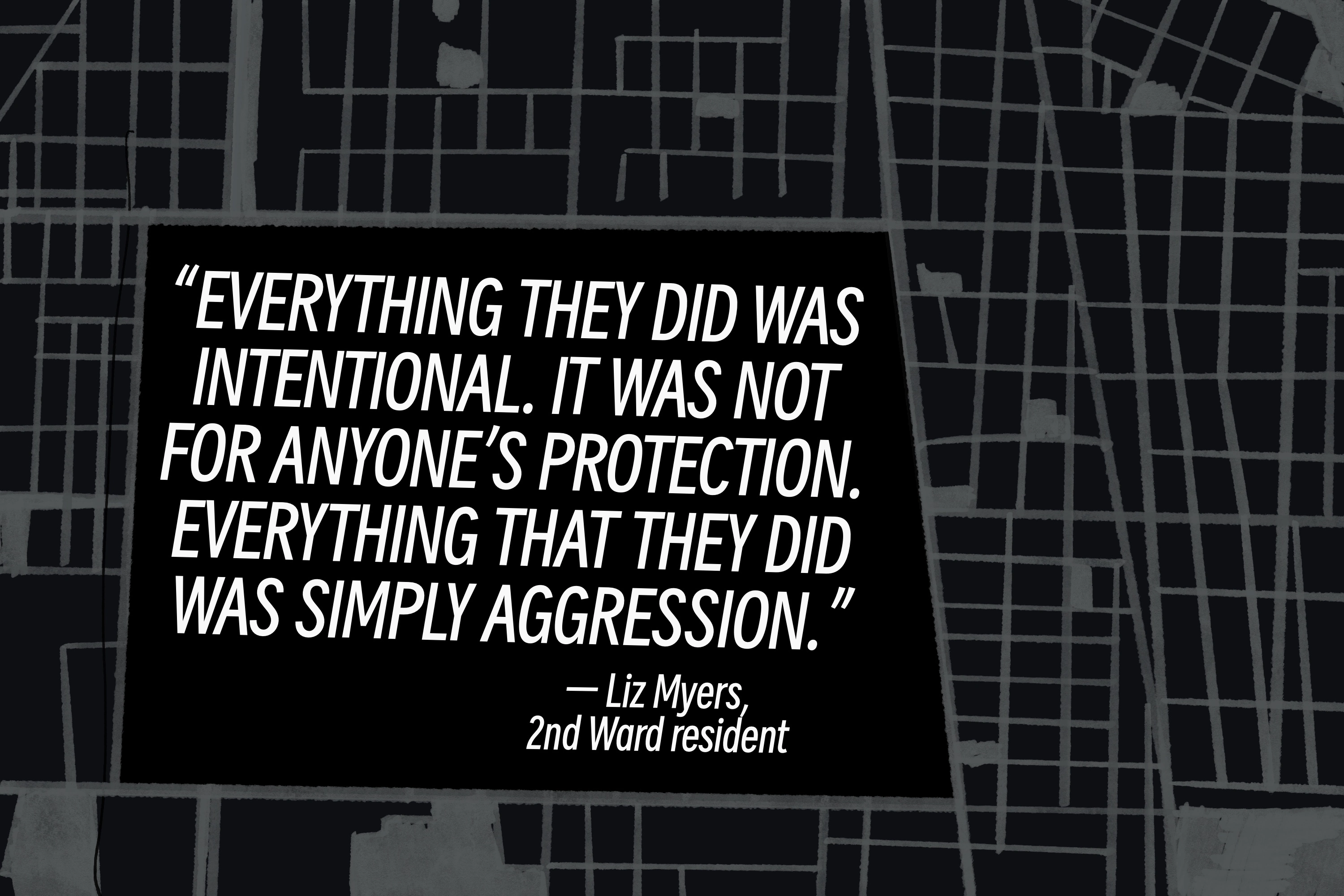
Second Ward resident Liz Myers said she was near Maxa when he used the pepper spray.
“Everything that they did was intentional,” Myers told The Daily hours after the detainments. “It was not for anyone’s protection. Everything that they did was simply aggression.”
Parsons, Donahue and Maxa did not respond to requests for comment for this story.
EPD supervisors arrived on scene about seven minutes after the crash to what one sergeant described to dispatchers as a “large crowd.”
Less than 30 seconds later, the sergeant’s partner, surrounded by bystanders in the street, told dispatch to “start everybody,” according to body-worn camera footage obtained by The Daily following a public records request. All available units were called to the scene, the footage shows.
“There was the Evanston Police Department, and they came, and we thought, ‘Oh, good, they’re going to detain (federal agents) there,’” one eyewitness told The Daily near the crash site.
EPD officers blocked traffic around the intersection and performed crowd control, sometimes in tandem with federal agents, the footage indicates.
The body camera of EPD Cmdr. Gil Levy, who was a sergeant at the time, captures him telling protesters they were violating a municipal ordinance and state law by being in the roadway. It then shows him walking over to his police cruiser and speaking into the loudspeaker.
“Anybody assaulting or threatening law enforcement is subject to arrest,” Levy said to the crowd, as captured on multiple officers’ body cameras. “Get out of the street and let the Evanston Police Department handle it.”
A little more than three minutes after the supervisors’ arrival, Border Patrol agent Parsons struck up a conversation with EPD Cmdr. Jodie Hart, which was captured on Hart’s body camera.
Parsons told the commander he wanted to fill out a crash report and then clear the scene. Hart had a different order in mind.
“Would it be possible before we get off to relocate somewhere else?” Hart asked.
Parsons gave his approval.
Hart instructed Parsons to meet EPD officers at the intersection of Howard Street and Damen Avenue, which sits at the border of Evanston and the Rogers Park neighborhood of Chicago.
EPD officers at the crash scene did not verify any agents’ affiliation with the federal government before Hart instructed them to meet at a new location, according to all body camera footage obtained by The Daily.
While Hart collected the full name of Parsons, he did not ask for the agent’s badge number, which was first collected nearly 50 minutes later, the footage shows. A U.S. district judge ruled earlier in October that federal immigration agents must wear badge numbers or other visible identification while on duty. Parsons’ badge number was not visibly displayed.
Following Hart’s conversation with Parsons, the commander told the agents to “follow me,” and began walking north on Asbury Avenue.
One bystander stood in front of the Chevrolet Tahoe driven by Border Patrol agent Donahue as he drove by Hart. The commander yelled at the bystander to “get out of the way, sir,” his body camera footage shows.
“They’re trying to surround this Tahoe,” another officer said into the radio after the government vehicle ran into the bystander. “Let the Tahoe out.”
From EPD supervisors’ arrival to the federal vehicle being led off scene, the events lasted a little more than six minutes.
Three U.S. citizens remained inside the vehicle. They would be held by federal officials for more than five hours, according to the IAC brief.
“The police helped the kidnappers, unidentified, escape a scene where they caused the accident, threatened people with guns in their faces, and with tear gas,” one eyewitness told The Daily near the crash site.
A ‘tricky’ legal landscape
Two legal experts questioned EPD supervisors’ actions at the scene of the crash.
Both Evanston’s Welcoming City Ordinance and a state law, the Illinois TRUST Act, contain clauses forbidding police from setting up a “traffic perimeter” or providing “on-site support” to assist an immigration enforcement operation, which EPD officers may have done when blocking streets around the scene.
Fred Tsao, senior policy counsel at the Illinois Coalition for Immigrant and Refugee Rights, was a contributor to the 2025 revision of Evanston’s ordinance. He said the situation is more nuanced within the context of the city’s law.
“What we contemplated when we inserted the perimeter provision, specifically, is some kind of advanced collaboration where local police would fence off an area, ICE would come in, they would carry out the operation,” Tsao said. “What has gotten tricky over the last year and a half or so is, what if police respond to a call regarding something happening like a traffic accident? The police still have responsibilities to maintain public safety and maintain traffic flow.”
At the question of whether EPD’s blocking of streets around Asbury Avenue and Oakton Street constitutes the establishment of a traffic perimeter, Tsao shrugged.
The IAC brief notes multiple federal agents could have unlawfully exceeded their authority in their violent detainments of citizens. Whether this could have spurred EPD officers to detain agents is uncertain, the experts said.
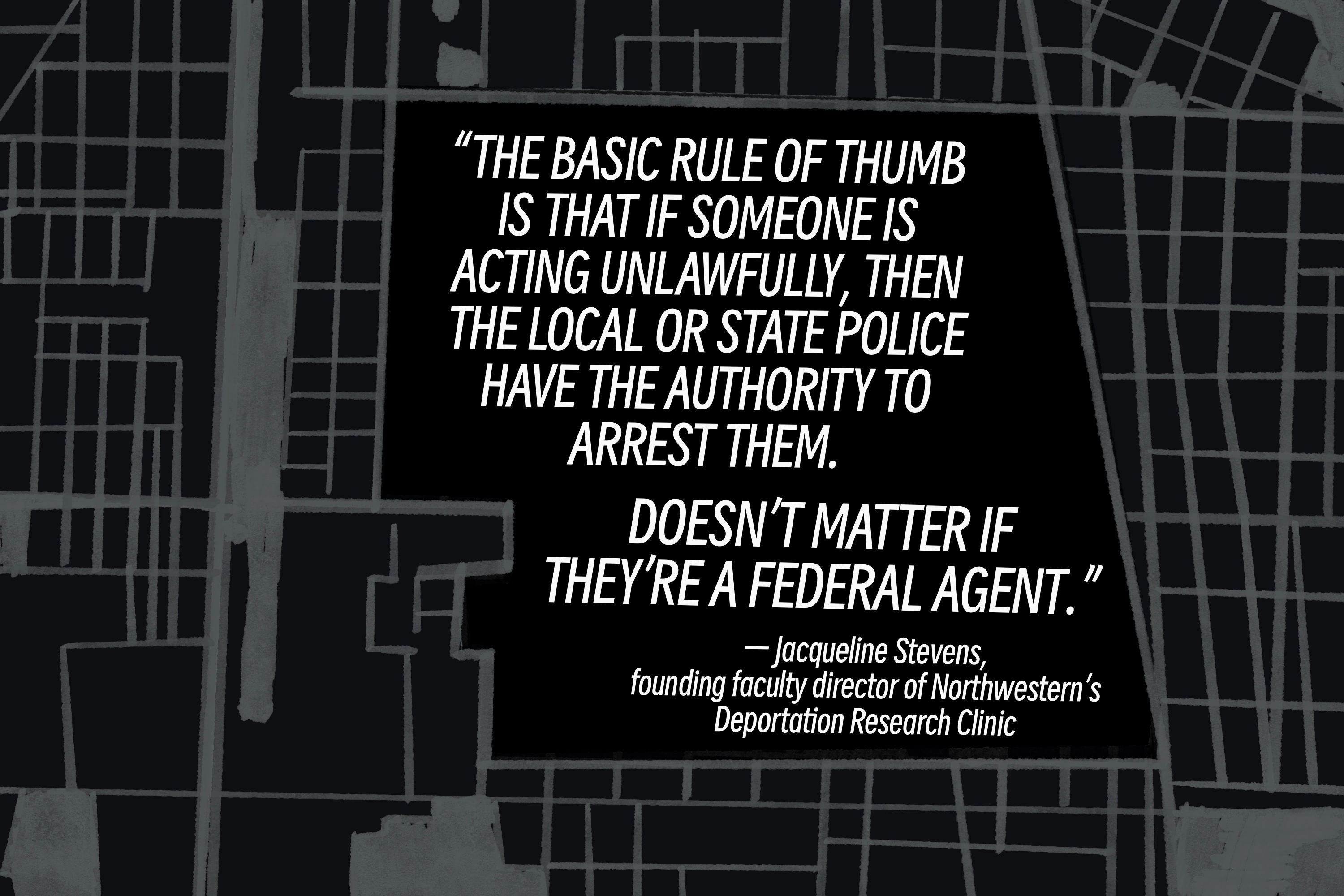
It depends if the agents’ actions were understood to be lawful, according to Jacqueline Stevens, founding faculty director of Northwestern’s Deportation Research Clinic and NU political science professor.
“The basic rule of thumb is that if somebody is acting unlawfully, then the local or state police have the authority to arrest them,” she said. “Doesn’t matter if they’re a federal agent.”
EPD’s Stewart wrote to city officials on the evening of the detainments that federal agents “cannot be detained or delayed by local police” when they are “operating under lawful authority.”
What actions fall within that lawful authority remains “at very least an open question,” according to Tsao.
“It is troubling that a city law department would waive away the possibility of at very least investigating, if not outright prosecuting, activity that is in violation of general laws,” he said.
EPD’s approach toward cases involving federal agents was “much more lenient than how I would read it, and maybe more lenient than what case law may actually provide,” Tsao later added.
“Lawful authority is open to interpretation, so you can’t just automatically say, ‘Well, we can’t do this,’” Tsao said.
On Oct. 31, EPD officers and 911 dispatchers repeatedly told bystanders that police could not interfere with federal agents.
Shortly after Hart let the agents drive away from the scene, for example, a bystander asked him, “Can they actually take people like this?”
“Sir, they’re federal agents, OK?” he responded, as shown in his body camera footage.
Mayor Daniel Biss wrote in a May 1 statement to The Daily that he has “had multiple detailed conversations with EPD and City of Evanston leadership reviewing the incident to better understand what can be learned to improve any response in the future.”
That day, Biss also re-sent a copy of a statement The Daily received in November, where he wrote he was “grateful for the role the Evanston Police Department played amid the chaos” on Oct. 31 and that there was “simply no way” the response could have been “perfect.”
‘Not gonna get in any Welcoming Ordinance trouble’
After federal agents arrived at the location Hart had decided on, which sat on the city’s border with Rogers Park, they drove around the Chicago neighborhood. Border Patrol agent Donahue repeatedly threatened community members with pepper spray, civilian videos show.
Agents’ “brutal tactics” were an “authoritarian overreach,” wrote Julian Jackson of activist group Protect Rogers Park in a late April statement reflecting on the events of Oct. 31.
Federal agents “brake-checked” vehicles that were following them in Rogers Park at least three times, according to the IAC brief.
After reporting to EPD that the Rogers Park area was “way too hot” with “some unruly tailing,” federal agents instead arranged to meet EPD Sgt. Daniel Keeler at the Skokie Northshore Sculpture Park, just outside Evanston’s western border.
Keeler then called with Hart, his supervisor, to break the news.
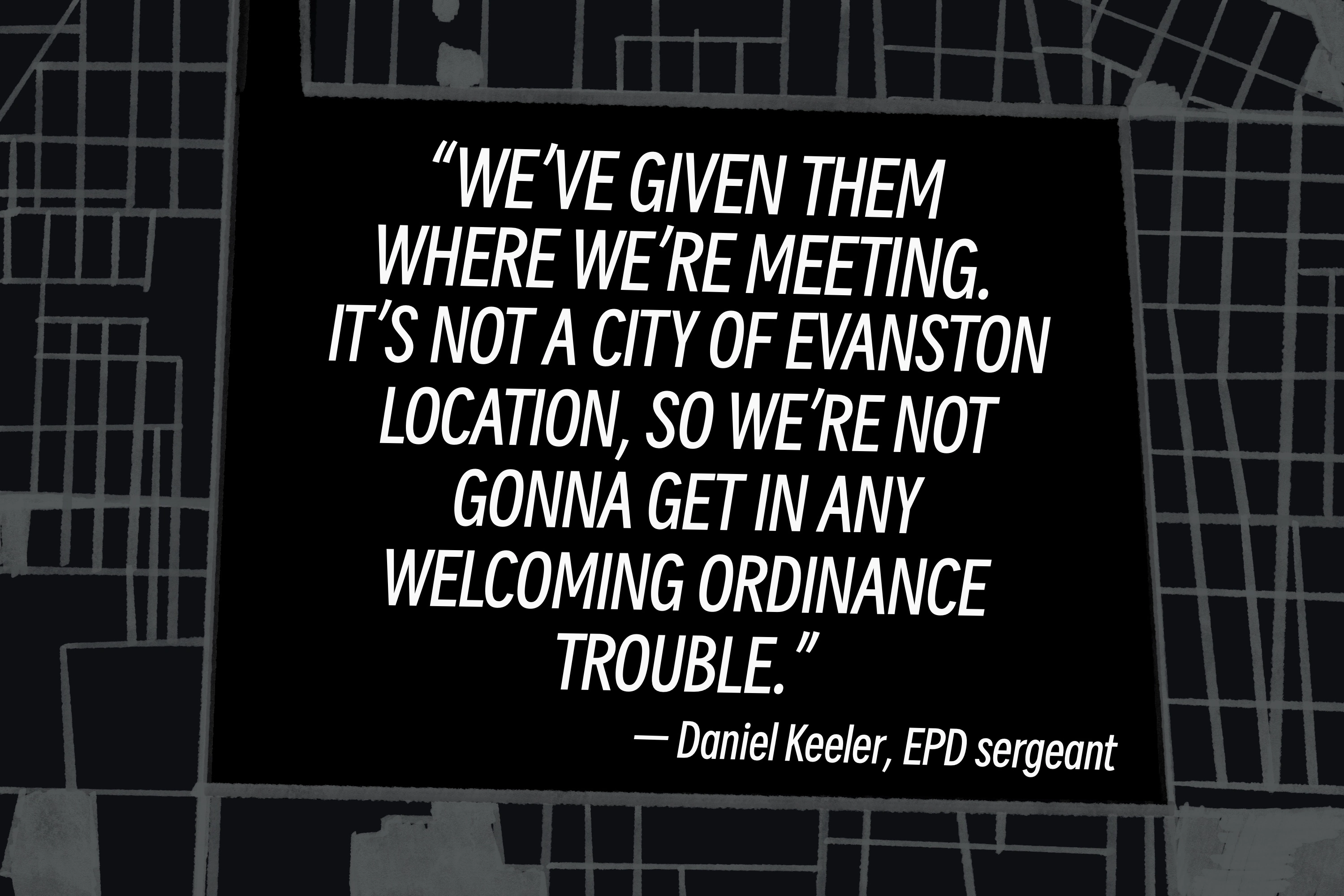
“We’ve given them where we’re meeting,” Keeler said in the call, captured on his body camera. “It is not a city of Evanston location, so we’re not gonna get in any Welcoming Ordinance trouble.”
City officials have referred to the Welcoming City Ordinance as the Welcoming Ordinance in public communications, including news releases and social media posts.
Jackson called the officers’ choice to meet outside city bounds “distressing.”
“Evanston police betrayed the people they are supposed to serve and undermined these neighbors’ heroic efforts to protect each other,” Jackson wrote.
To Tsao, the choice of location was the “most confusing aspect of this whole episode.”
He noted the ordinance was “not restricted to the city of Evanston” for city employees, including police officers.
“I really don’t understand what difference it makes where this interaction is happening,” Tsao said. “It certainly should not make any difference whether this is within Evanston city limits or outside.”
EPD declined to comment on the incident in November and did not respond to questions in April about why Hart and Keeler chose meeting locations on or outside city boundaries.
EPD’s Stewart, Levy, Hart and Keeler did not respond to an additional request for comment in May for this story.
The Daily obtained still-unpublished comments emailed by Stewart in January to the Evanston RoundTable, which partially shed light on EPD’s decision-making process.
“(The choice of location) was not an attempt to skirt the ordinance,” Stewart wrote in the email. “I made that decision, and I reiterated to EPD staff that federal agents were not permitted to come to the Evanston Police Department or any other city property to exchange information.”
The statement appears to reference parts of the ordinance and TRUST Act, which both contain clauses forbidding immigration agents from using police department facilities.
Half a year after the incident, Myers, who witnessed Evanston police’s interactions with the agents on Oct. 31, is still looking for answers.
“(Police) are not going to do anything to stop this, and they don’t want to,” she told The Daily in April. “I don’t understand why they wouldn’t want to.”
The only possibility she could think of was that police officers “don’t want to be targets themselves.”
“Nothing has changed,” Myers said. “If any of this happens again, they’re not going to protect us.”
Siddarth Sivaraman contributed reporting.